Quick Answer Box: Decarboxylation of THCa is the chemical process that uses heat to remove the carboxyl group from THCa, converting it into psychoactive Delta-9 THC. It happens the moment you light a bowl, hit a vape, or bake flower in an oven between 220–245°F for 30–45 minutes.
What Is the Decarboxylation of THCa?
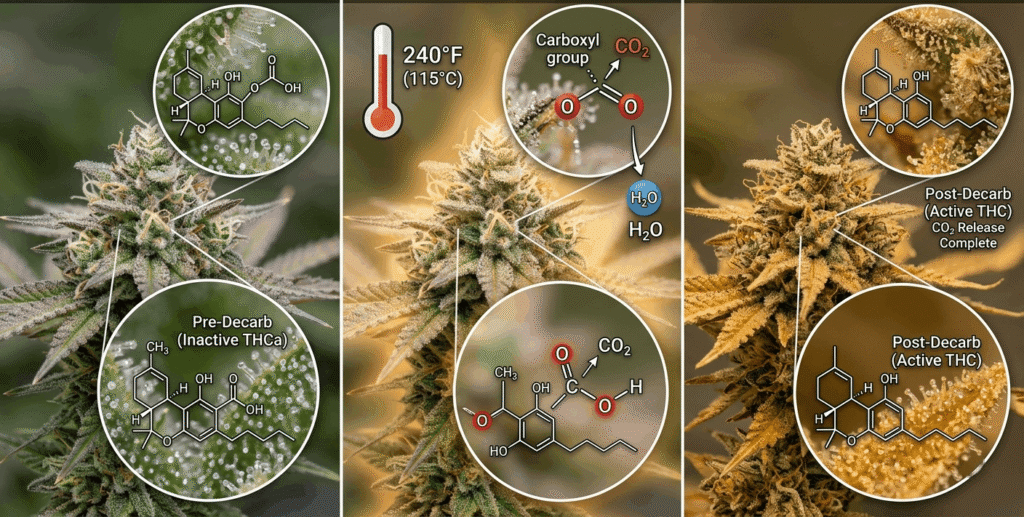
Decarboxylation of THCa is the heat-driven chemical reaction that strips a carboxyl group from tetrahydrocannabinolic acid (THCa), converting it into Delta-9 THC. In its raw form, THCa is non-psychoactive. Apply enough heat, and a molecule of CO2 exits the compound. What remains is THC — the active cannabinoid responsible for the effects cannabis consumers seek. Without this conversion, your flower won’t deliver what you expect.
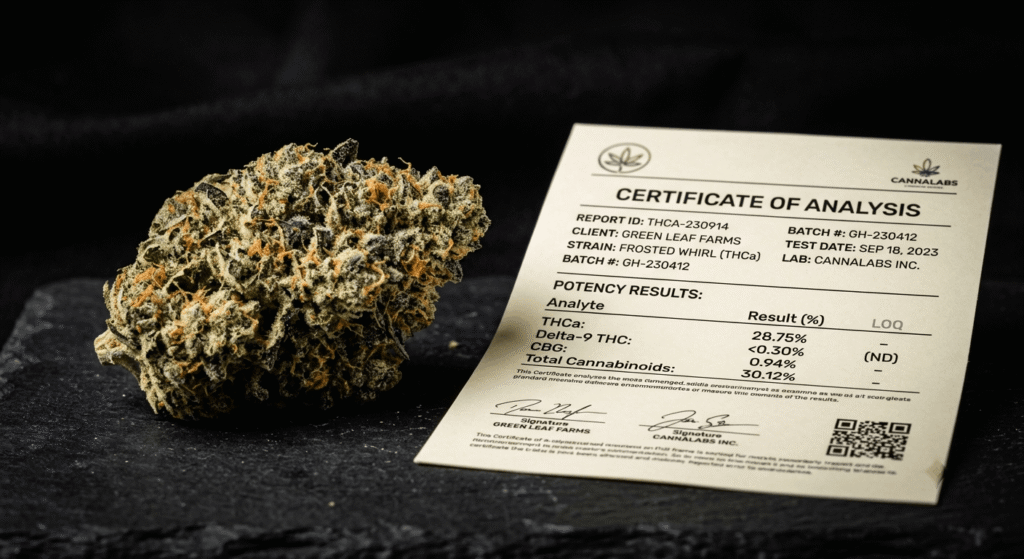
Raw hemp and cannabis plants naturally produce cannabinoids in their acidic state. THCa is the dominant one in most high-potency strains. A quick look at any Co Exotics lab result confirms what’s really in your flower before heat ever touches it: mostly THCa, not THC. That number changes the second you apply a flame.
Why Does THCa Need to Be Decarbed to Get You High?
The reason is molecular. THCa carries an extra carboxyl group a cluster of carbon, oxygen, and hydrogen atoms that makes the molecule too large to bind efficiently to the CB1 receptors in your brain’s endocannabinoid system. Those receptors govern psychoactive response. THCa simply doesn’t fit the lock.
Decarboxylation removes that extra group. The resulting THC molecule is smaller, more lipid-soluble, and binds to CB1 receptors directly. That binding is what produces the high. Research published in Industrial & Engineering Chemistry Research confirmed that THCa actually has the fastest decarboxylation rate among all cannabinoid acids, meaning it converts to THC more efficiently with heat than CBDA or CBGA do.
There’s also a conversion math worth knowing. For every gram of THCa in your flower, you get roughly 87.7% of that weight as THC after full decarboxylation. So flower testing at 25% THCa has the potential to yield about 21.9% THC after a clean, complete decarb. Real kitchen results run slightly lower due to uneven heat and surface loss but that formula is your starting point for dosing edibles.
One thing most guides miss: natural, slow decarboxylation happens even at room temperature over time. Old, improperly stored flower loses THCa to this passive conversion, which is why freshness and airtight storage matter. Buying quality high-THCa indoor flower and storing it correctly preserves that full starting percentage until you’re ready to activate it.
What Is the Best Way to Decarb THCa at Home?
The oven method is the most reliable and accessible approach. It gives you consistent, even heat without specialized equipment.
What you need: baking sheet, parchment paper, aluminum foil, an oven thermometer, your THCa flower.
Step 1 — Preheat correctly. Set your oven to 240°F (115°C). Don’t trust the dial. Most home ovens run 10–25°F hotter or cooler than displayed, and that gap matters. An oven thermometer costs under $15 and removes the guesswork entirely.
Step 2 — Break up your flower. Coarse, pea-sized pieces work best. Don’t powder it. Over-grinding increases surface area to the point where the flower scorches before it fully converts. Scissors or a grinder on the coarsest setting are fine.
Step 3 — Spread in a single layer. Lay the flower on parchment paper with room between pieces. Overcrowding creates hot spots and uneven activation.
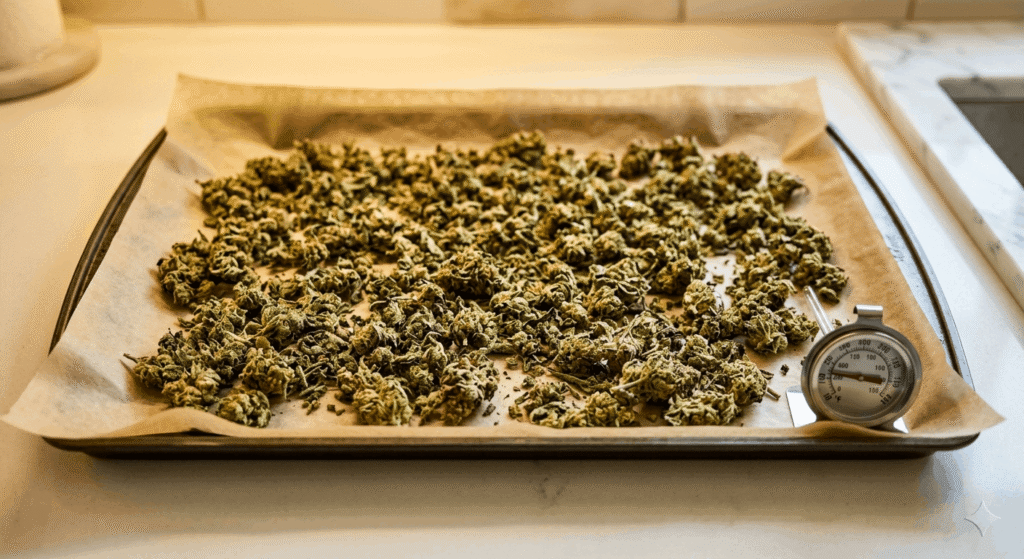
Step 4 — Cover loosely with foil. This traps terpenes that would otherwise escape as vapor. Terpenes are volatile, and heat is their enemy. Keeping them contained improves flavor and preserves the entourage effect. If you want to learn more about how terpenes interact with cannabinoids, the Co Exotics guide to terpenes breaks it down.
Step 5 — Bake for 30–45 minutes. Stir once at the halfway mark for even exposure. At 240°F, the reaction accelerates steadily. Most of the THCa-to-THC conversion happens in this window. The flower should turn light golden brown. Dark brown means it’s gone too far.
Step 6 — Cool completely before handling. Hot decarbed flower is fragile and resinous. Let it sit for 30 minutes. Store in an airtight container away from light.
For those who prefer a slower, more terpene-preserving approach: 220°F for 45–50 minutes also works and is gentler on aromatics. For edibles where raw potency matters most, 250°F for 25–30 minutes is the faster alternative. Lower temps favor flavor; higher temps favor speed.
| Method | Temp | Time | Best For |
|---|---|---|---|
| Low & Slow | 220°F | 45–50 min | Terpene preservation, flavor |
| Balanced | 240°F | 30–40 min | General use, edibles |
| Fast Activation | 250°F | 25–30 min | Max conversion speed |
| Smoking/Vaping | Instantaneous | Seconds | Direct consumption |
Smoking and vaping decarb your flower the moment heat touches it. No oven required. If your goal is direct consumption rather than infusions, the plant handles its own activation the second you light it.
Does Decarbing Affect Terpenes and Flavor?
Yes, significantly. Terpenes like myrcene, pinene, and linalool evaporate at temperatures that overlap with the decarboxylation range. That’s why high heat isn’t always better. Blasting flower at 300°F burns off terpenes fast, leaving behind a flat, bitter result with degraded THC converting into CBN a far less potent, more sedating compound.
Staying under 250°F with the foil cover on is the practical answer. It’s a balance: enough heat to drive conversion, not so much that you sacrifice what makes quality flower worth buying. The entourage effect the synergy between THC, CBD, and terpenes depends on those aromatic compounds making it through the process intact.
Frequently Asked Questions
1. Does THCa get you high without decarboxylation?
No. Raw THCa is non-psychoactive. It doesn’t bind to CB1 receptors in a way that produces intoxication. You’d need to consume very large amounts of raw flower to feel minimal effects. Heat is what unlocks THC’s psychoactive properties, whether from a lighter, vape, or oven.
2. What happens if I decarb at too high a temperature?
Above 300°F, THC starts degrading into cannabinol (CBN). CBN has sedative properties but is far less psychoactive than THC. You’ll also lose terpenes, which kills flavor and reduces the entourage effect. The result is weaker, flatter, and harsher. Staying at 220–250°F protects both potency and quality.
3. Do I need to decarb THCa flower before smoking or vaping?
No. Smoking and vaping apply heat directly and instantly, triggering decarboxylation at the point of consumption. Pre-decarbing is only necessary when making edibles, tinctures, or infused oils, where the flower won’t be exposed to high heat during use. If you want to explore concentrates that are ready for heat-based consumption, the Co Exotics concentrates collection has options built for exactly that.
4. How do I know when decarboxylation is complete?
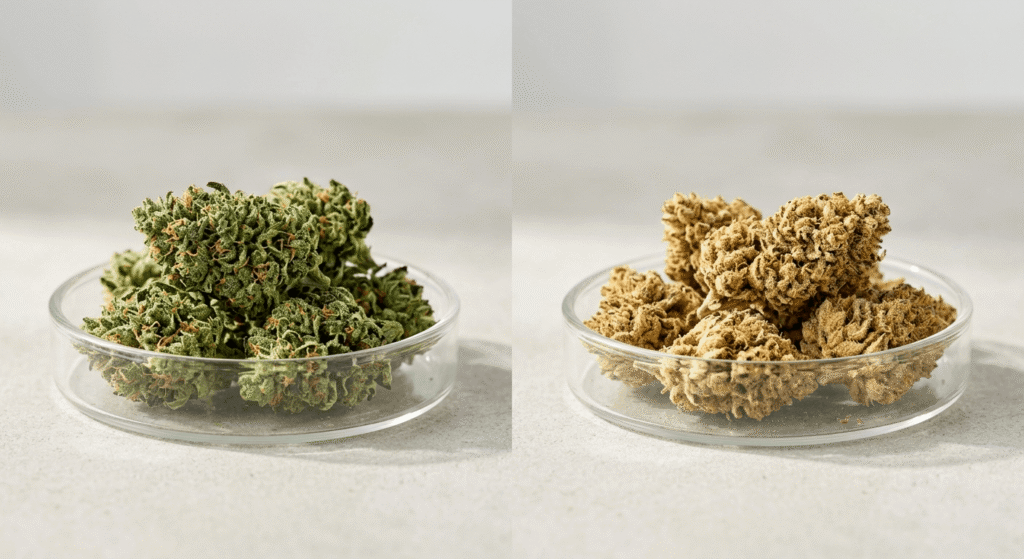
Visual cues are your best guide. Flower that’s done will shift from its original green to a light golden or pale brown color. It’ll feel dry and slightly crumbly compared to fresh bud. If it’s still vivid green after 30 minutes at 240°F, give it another 10 minutes. Dark brown or near-black means it overshot terpenes are gone and some THC has already degraded into CBN.
5. Can I decarb THCa concentrates the same way as flower?
Yes, but with shorter times. Concentrates like rosin, badder, or crumble have less water content and more surface area exposed to heat, so they convert faster. Spread them in a small oven-safe dish lined with parchment, cover with foil, and bake at 240°F for 20–30 minutes rather than 30–45. Check at the 20-minute mark. For live resin or rosin specifically, the lower end of that range protects the terpene profile better.
Conclusion
Decarboxylation of THCa is the chemistry behind every cannabis experience that involves heat. One extra molecular group, removed by controlled temperature, transforms a non-active compound into Delta-9 THC. Nail the process 240°F, 30–40 minutes, foil cover, oven thermometer and you get consistent, full-potency results whether you’re making edibles or just understanding what happens when you light your flower. Start with quality flower, and the activation does the rest.