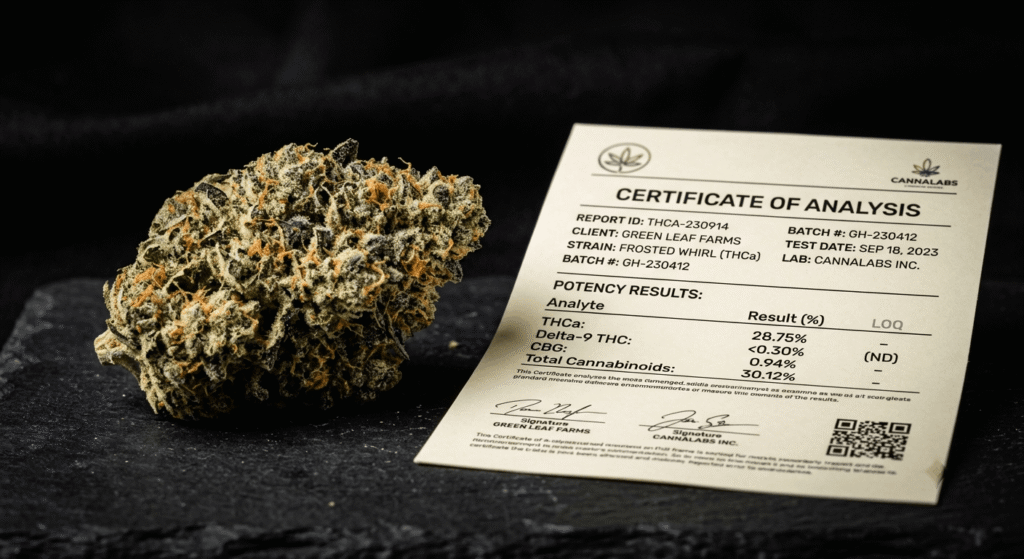
Quick Answer Box: To learn how to read terpene profiles, pull up the product’s Certificate of Analysis and check three things: total terpene percentage, which individual terpenes sit above 0.5%, and the test date. Flower with total terpenes above 2% is generally considered flavorful, and the dominant terpene predicts effect better than an indica or sativa label.
What Is a Terpene Profile?
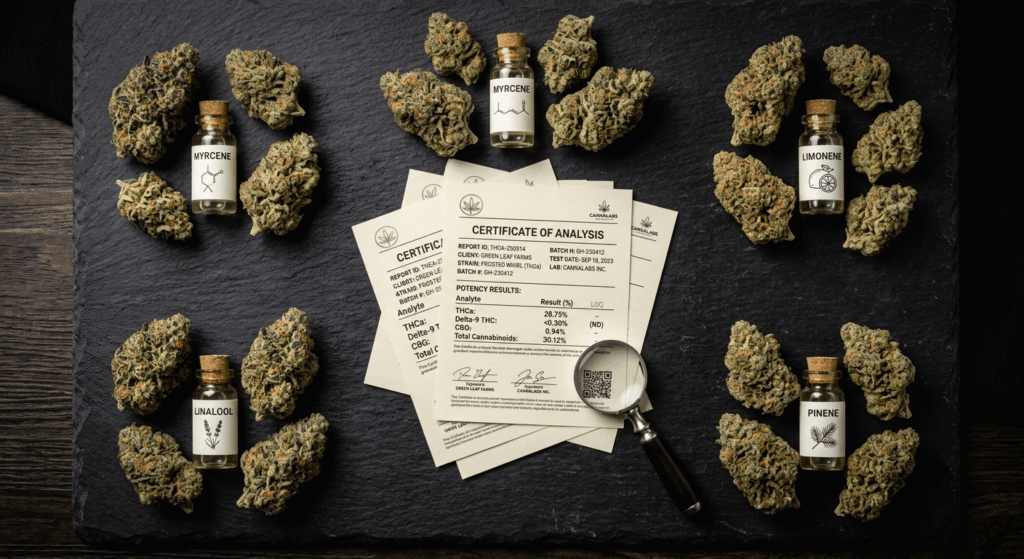
A terpene profile is the lab-verified list of aromatic compounds found in a hemp flower or concentrate, shown as individual percentages by weight on a Certificate of Analysis. These compounds are what give a strain its smell and flavor, from citrus to pine to earthy diesel. They also play a role in how a product feels, not just how it tastes.
Terpenes aren’t unique to cannabis. You’ll find limonene in orange peel and pinene in rosemary. What makes a hemp terpene profile useful is that it’s measured, not guessed. Instead of trusting a strain name or a marketing photo, you’re looking at actual gas chromatography data pulled from that specific batch.
How Do You Read a Terpene Profile on a Hemp COA?
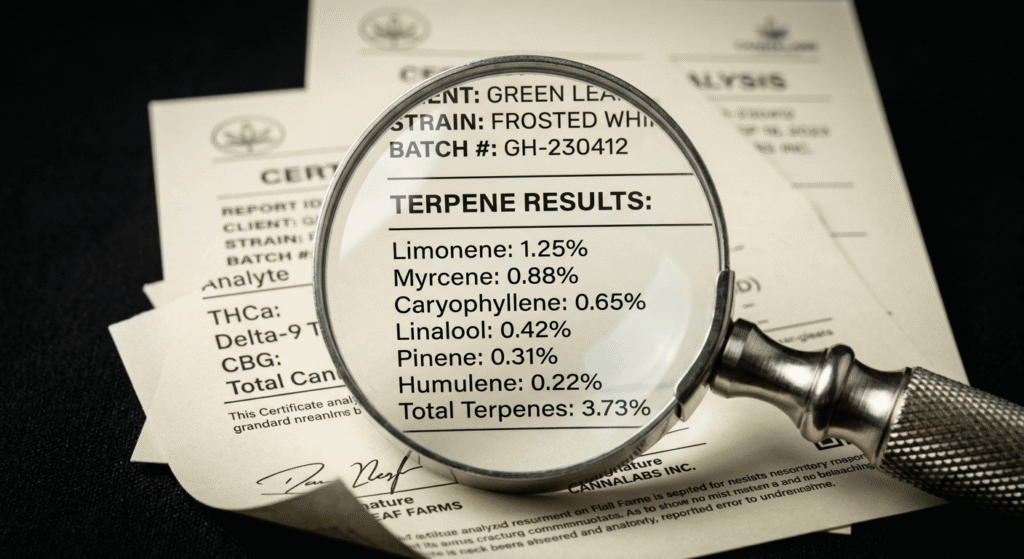
Start at the top of the COA and confirm the batch number matches your product, then scroll to the terpene panel and scan for the highest percentages first. <cite index=”3-1″>Cannabinoids tell you potency, terpenes tell you character, and contaminant results tell you whether the batch is safe to consume</cite>. Reading the terpene section specifically comes down to three habits.
Terpene Percentages and What They Signal
First, look at total terpene content. <cite index=”29-1″>Most quality flower ranges from 1% to 3% total terpenes, and anything above 2% is considered terpene-rich with a pronounced aroma and flavor</cite>. A jar sitting at 0.6% total terpenes will usually smell flat next to one testing at 3%, even if the THCa numbers are identical.
Second, identify the dominant terpene, meaning whichever compound has the highest individual percentage. <cite index=”7-1″>Terpenes present above roughly 0.5% have the most influence on aroma, flavor, and the overall experience of the strain</cite>. A batch showing 1.2% limonene as the lead terpene is going to smell and feel noticeably different from one led by 0.9% myrcene, even if both are labeled “hybrid.”
Third, check the test date. <cite index=”7-1″>Terpenes are volatile and can degrade with heat, light, and air exposure, so products tested more than 90 days before purchase may no longer reflect what’s actually in the jar</cite>. Storage matters here too. Cool, dark, airtight containers slow that loss; a sunny windowsill accelerates it.
#Not every lab will land on the exact same number for the same jar, and that’s worth understanding before you compare two COAs side by side. <cite index=”32-1″>Gas chromatography, the industry standard for terpene testing, requires vaporizing the sample, and the heat involved can degrade the most volatile compounds before they reach the detector</cite>. That means terpinolene, beta-ocimene, and limonene in particular can read lower than what’s actually in the flower, and two accredited labs testing the same batch can post meaningfully different totals without either one being wrong. <cite index=”27-1″>Reputable labs using GC-MS typically hold intra-day variation under roughly 8% and inter-day variation under roughly 11%</cite>, which is a useful benchmark if a brand ever shares its lab’s proficiency data.
Common Terpenes in Lab-Tested Hemp Flower
Not every COA runs a full terpene panel. <cite index=”8-1″>Terpene testing is often an optional add-on, and when a brand does include it, common entries include myrcene (earthy, sedating), limonene (citrus, uplifting), caryophyllene (spicy, anti-inflammatory), pinene (pine, alertness), linalool (floral, calming), and humulene (hoppy, appetite suppression)</cite>. A short panel that only lists three or four terpenes isn’t necessarily dishonest, but a deeper panel gives you a fuller picture before you buy.
Here’s how the most common ones tend to line up on a typical lab-tested terpene chart:
| Terpene | Aroma | Common Effect Association | Notable Threshold |
|---|---|---|---|
| Myrcene | Earthy, musky | Body-relaxing, sedating | <cite index=”10-1″>Above 0.5% is considered body-relaxing</cite> |
| Limonene | Citrus | Uplifting, mood-forward | <cite index=”10-1″>Above 0.3% is considered uplifting</cite> |
| Pinene | Pine, fresh | Alertness, focus | <cite index=”10-1″>Above 0.3% is associated with focus</cite> |
| Caryophyllene | Peppery, spicy | Warming, grounding | Often paired with myrcene in indica-leaning profiles |
| Linalool | Floral, lavender | Calming | <cite index=”10-1″>Present at any notable level, linked to calm</cite> |
What Do THCa Terpene Percentages Actually Mean for Effects?
THCa terpene percentages tell you how a strain is likely to taste and feel, but they aren’t a medical guarantee. Research on the so-called “entourage effect”, the idea that terpenes and cannabinoids work together to shape the overall experience, is still developing and genuinely mixed. <cite index=”24-1″>A 2024 systematic review found exploratory evidence for benefits such as myrcene’s relaxing properties and linalool’s role as a sleep aid, while other proposed mechanisms showed weaker or inconsistent support</cite>. Some lab work looking directly at cannabinoid receptors has found terpenes can act on the same pathways as cannabinoids, lending support to the general idea even where specific claims remain unsettled.
Practically, this means you can use terpene levels as a reasonable guide, not a promise. A flower dominant in myrcene and caryophyllene tends to skew toward a heavier, wind-down feel. One led by limonene and pinene tends to skew brighter and more energetic. Two strains with the same THCa percentage can still feel completely different because of this underlying terpene chemistry, which is exactly why the profile matters as much as potency.
It’s also worth understanding what you’re buying under, legally. As of November 12, 2026, the federal definition of hemp shifts from a delta-9-only threshold to a total THC standard. <cite index=”15-1″>The amended law defines hemp as cannabis with a total THC concentration, including THCA, of not more than 0.3 percent on a dry weight basis</cite>. That change affects potency compliance, not terpene testing directly, but it’s the legal backdrop every current hemp COA sits inside.
Concentrates read differently than flower. <cite index=”18-1″>Live resin and similar extracts can carry terpene content well above what raw flower holds, sometimes running from 3% up to 12% or more depending on the extraction process</cite>, so don’t compare a rosin’s terpene percentage directly against a flower’s and assume one is simply “better.”
Frequently Asked Questions
1. What counts as a good terpene percentage in flower?
<cite index=”8-1″>A total terpene content above 2% is generally considered good for flower, and above 3% to 4% is considered excellent</cite>. Anything under 1% usually reads as mild in aroma and flavor, regardless of the strain name on the label.
2. How is a hemp terpene chart different from a cannabinoid panel?
A cannabinoid panel measures potency, primarily THCa and total THC. A terpene chart lists individual aromatic compounds and their percentages by weight. Together they explain both strength and character, but only the terpene chart tells you what a jar will actually smell and taste like.
3. Do all lab-tested products include terpene results?
No. Terpene testing is frequently optional, and panel size varies by lab.
- Some COAs list only the top 3 to 5 terpenes
- Full panels can cover 20 or more compounds
- <cite index=”7-1″>State testing laws vary, so a full panel isn’t always required</cite>
- A missing terpene section isn’t automatically a red flag, but it does limit what you can judge before buying
4. Should you trust a terpene chart that only lists a few terpenes?
Yes, with some caution. A short panel of three to five terpenes still tells you the dominant compounds driving aroma and effect, since those are almost always the ones a lab prioritizes. What you lose is visibility into minor terpenes, so treat a short panel as a partial picture rather than a red flag on its own.
5. How should you store flower to protect its terpene profile?
Keep it in an airtight glass container, away from direct light and heat. <cite index=”7-1″>Terpenes are volatile and break down when exposed to heat, light, or air, so proper storage in cool, dark conditions helps maintain the profile shown on the COA</cite>. A jar left on a warm windowsill for a few weeks can lose noticeably more aroma than one kept in a closed cabinet.
Conclusion
Once you know how to read terpene profiles, a COA stops looking like a wall of numbers and starts working like a shopping tool. Check the total percentage, find the dominant terpene, confirm the test date, and you’ll pick flower and concentrates that actually match what you’re after instead of guessing from a strain name. You can browse Co Exotics’ own lab results before your next order to see full terpene and cannabinoid panels for yourself, or start with our indoor flower collection if you want strains grown specifically for stronger terpene expression.